Commission-Based Sales Agent: The Complete Guide for India
Key takeaways
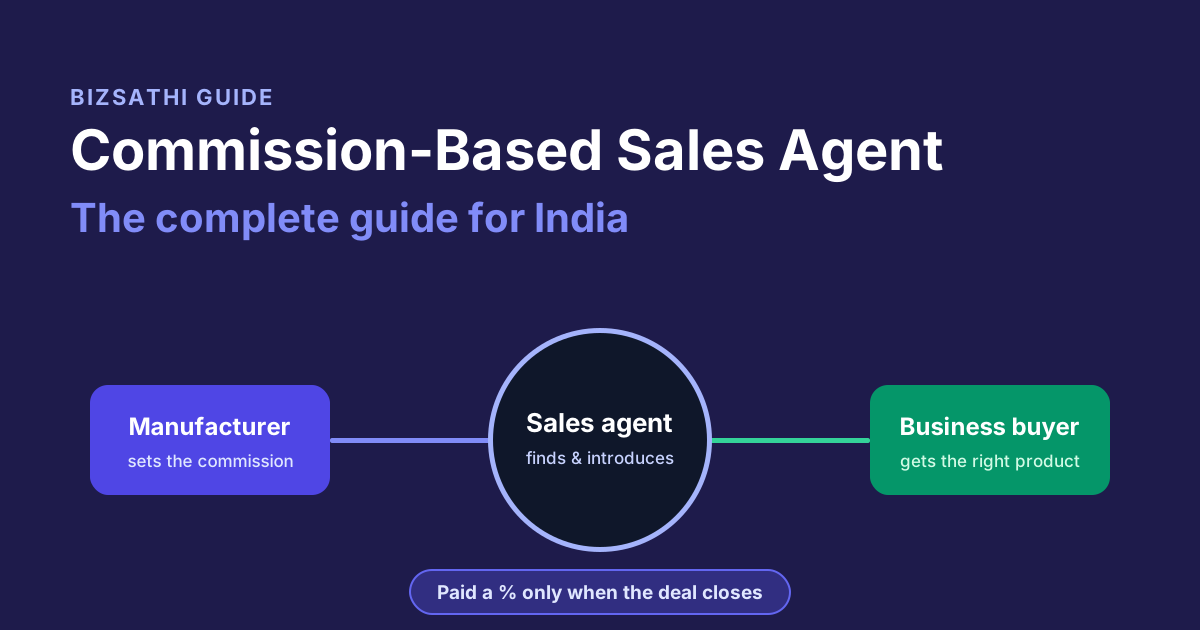
- A commission-based sales agent finds buyers for a company’s products and is paid a percentage of each deal that closes, instead of a salary.
- Agents are usually independent: they choose what to sell, work their own hours and can represent several companies.
- For companies, agents turn sales into a variable cost; for agents, the trade-off is uncapped earnings without guaranteed income.
- Clear written terms, verified identities and a time-stamped record of each lead prevent most disputes.
A commission-based sales agent is a person who sells a company’s products or services and is paid a percentage of each sale, rather than a fixed salary. If a deal closes, the agent earns a commission. If it doesn’t, the agent earns nothing — and the company pays nothing.
In India, commission agents have been part of B2B trade for generations: the agent who connects a textile mill with garment exporters, or brings contractors to a cement dealer. What is changing is how the arrangement works. Platforms now verify both sides, record every introduction and calculate commission automatically, which removes most of the arguments that used to come with it.
This guide is the starting point for everything about commission-based sales agents: what they do, how they are paid, how to become one and how to hire one.
What does a commission-based sales agent do?
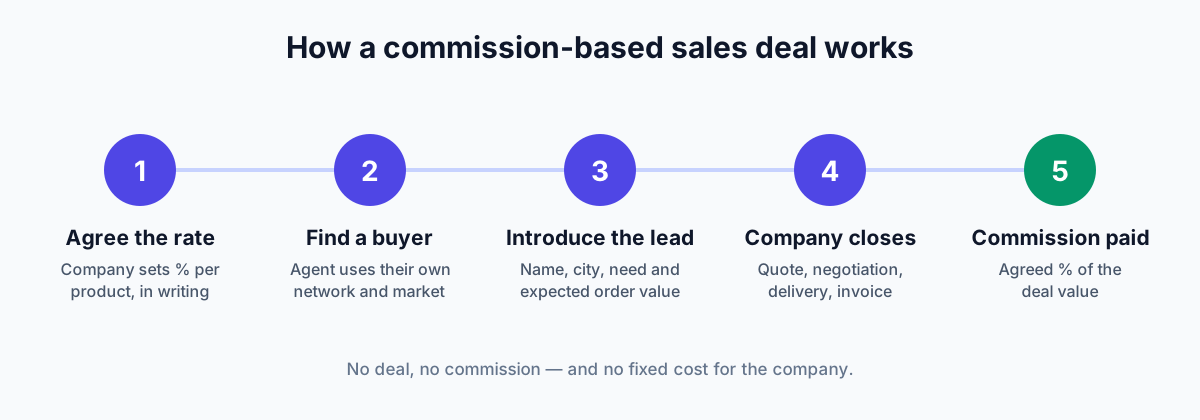
An agent’s job is to find buyers who genuinely need a product and introduce them to the company that makes it. In B2B sales, that usually means:
- Identifying businesses, contractors or institutions that buy a certain kind of product.
- Having a first conversation to confirm the need, budget and timeline.
- Passing the buyer to the company as a lead — name, city, contact details and expected order value.
- Staying in touch with the buyer until the deal closes or is lost.
The company does the rest: quotation, negotiation, delivery, invoicing and after-sales service. The agent does not buy or hold stock.
How commission-based sales agents are paid
The most common structure is a flat percentage of the deal value, agreed before the agent starts. A few worked examples:
| Product | Deal value | Commission rate | Agent earns |
|---|---|---|---|
| Industrial machine | ₹5,00,000 | 8% | ₹40,000 |
| Rooftop solar system | ₹2,00,000 | 5% | ₹10,000 |
| Office furniture order | ₹60,000 | 10% | ₹6,000 |
Other structures you will come across:
- Tiered commission — a higher percentage once the agent crosses a sales value in a month or quarter.
- Fixed amount per unit — common for standard products sold in quantity.
- Repeat-order commission — a share of repeat orders from the same buyer for an agreed period.
On BizSathi, most products offer between 3% and 15% of deal value, and the rate is shown on every listing before an agent starts. For a deeper look at how the model works for both sides, read what commission-based selling is.
Commission agent vs distributor vs salaried salesperson
| Commission sales agent | Distributor | Salaried salesperson | |
|---|---|---|---|
| Employment | Independent | Independent business | Employee |
| Holds stock | No | Yes | No |
| How they earn | % of closed deals | Margin on resale | Salary + incentive |
| Cost to the company before a sale | None | Credit terms, schemes | Salary, travel, training |
| Works with several companies | Usually | Yes | No |
Commission agents suit products sold order by order — machinery, solar, furniture projects, packaging, software, custom manufacturing. Distributors suit fast-moving products that need local stock. Many manufacturers use both.
Pros and cons
For companies
- Pro: no fixed salary — sales cost rises only when revenue does.
- Pro: reach cities and buyer segments where you have no team.
- Pro: several agents can work your product in parallel.
- Con: you can’t direct an independent agent’s time; you can only make your product attractive to sell.
- Con: informal arrangements lead to disputes about who introduced which buyer.
For agents
- Pro: no cap on earnings, no boss, no fixed hours.
- Pro: earn from relationships you already have, across multiple companies.
- Con: no guaranteed income — B2B deals can take weeks or months to close.
- Con: commission promised verbally is sometimes paid late or not at all.
Most of the cons come from missing records. Written terms, verified identities and a shared, time-stamped lead history solve them.

How to become a commission-based sales agent in India
- Pick a niche you understand — an industry where you already know buyers, such as construction, healthcare, education, manufacturing or retail.
- Get verified. On BizSathi that means registering and completing PAN and Aadhaar KYC, so companies can trust your leads and you can receive payouts.
- Choose three to five products your contacts genuinely need. A focused portfolio converts far better than a long list.
- Qualify before you submit. Confirm need, budget and timeline, and make sure the buyer expects a call.
- Follow up until the deal closes, and track every lead’s status.
There are more detailed guides for each situation: commission-based sales jobs, working as an independent sales agent, freelance sales agent jobs and earning commission by selling products. If you are looking for what to sell, see our list of commission-based business ideas in India.
Ready to start earning commission?
Join BizSathi as a sales agentHow to hire commission-based sales agents
- Define exactly who buys your product — “solar EPC contractors in Maharashtra” is useful; “businesses” is not.
- Set a commission that works for your margin and the effort needed to sell.
- Give agents brochures, an indicative price list and your delivery area.
- Judge agents on their first few leads, not on promises.
- Follow up every lead quickly and pay commission on time — the best agents stay with companies that do.
For the full process, read how to find sales agents in India, or see how hiring commission-based sales agents compares with a salaried team and with outsourced sales options for SMEs.
Put your products in front of verified agents across India.
Join BizSathi as a manufacturerAgreements, GST and TDS
Whichever side you are on, put the terms in writing before any work starts:
- The commission rate for each product, and whether it is on the pre-tax or post-tax deal value.
- When commission becomes payable — on order, on delivery or on the buyer’s payment.
- How repeat orders from the same buyer are treated, and for how long.
- What happens when the company already knew the buyer, and how disputes are resolved.
Common mistakes
- Agents passing on cold contacts just to “claim” a buyer — it damages trust and wastes the company’s time.
- Companies recruiting more agents than they can follow up with the same day.
- Offering a commission too low for the effort, then blaming agents for low activity.
- Keeping terms verbal and records in personal phone notes.
- Judging the arrangement after one week instead of one or two full sales cycles.
How BizSathi supports commission-based sales
BizSathi is built around the record-keeping that makes commission sales fair for both sides. Companies are verified with GST documents and agents with PAN and Aadhaar. Every listing shows its commission upfront. Each lead is time-stamped under the agent’s name and moves through clear stages — new, contacted, qualified, won or lost — that both sides can see. When a company marks a deal Won, the commission is calculated automatically and paid to the agent’s UPI or bank account, and either side can raise a dispute. See how it works for sellers and for agents.
Frequently asked questions
- What is a commission-based sales agent?
- A commission-based sales agent sells a company’s products or services and is paid a percentage of each deal that closes, instead of a fixed salary. In B2B sales, the agent usually finds and introduces the buyer, and the company handles quotation, delivery and invoicing.
- How much do commission-based sales agents earn in India?
- It depends on the products, deal sizes and how many leads close. On BizSathi, commission rates typically range from 3% to 15% of deal value — for example, an 8% commission on a ₹5,00,000 machinery order is ₹40,000. There is no guaranteed income.
- Is a commission agent an employee?
- Usually not. A commission agent is typically an independent contractor who is paid per result and can work with several companies. The exact relationship depends on the agreement between the parties.
- Do I need a licence to be a commission sales agent in India?
- For selling general B2B products such as machinery, furniture or packaging, there is no specific licence — you need a PAN, and possibly GST registration depending on your turnover. Some sectors are regulated: real estate agents generally need RERA registration, and insurance and mutual fund distribution need their own certifications.
- How do companies find commission-based sales agents?
- Through their own customers and suppliers, trade associations, trade fairs and agent platforms such as BizSathi, where KYC-verified agents browse listings and submit leads.
Start with BizSathi
Manufacturers list products and set the commission. Verified agents bring buyers. Commission is calculated automatically when a deal closes.