How Manufacturers Can Increase Sales Without Hiring Employees: 10 Proven Ways
Key takeaways
- The cheapest sales growth usually comes from customers you already have: repeat orders, bigger orders and referrals.
- Fast replies to enquiries and disciplined follow-up win more deals without adding a single person.
- To reach new markets without payroll, use channels you pay on results — commission-based sales agents and referral partners.
- Marketplaces, WhatsApp Business and a findable website bring buyers to you; distributors and trade fairs need more commitment.
- Start with two or three strategies, measure leads and wins by channel, and scale only what works.
For most small and mid-sized manufacturers in India, the obvious answer to “how do we sell more?” is “hire more salespeople.” But every new hire is a fixed monthly cost that starts long before the first order, and there is no guarantee they will perform. For many SMEs, that risk is exactly what holds growth back.
The good news is that hiring is only one way to grow. Many manufacturers increase sales significantly by getting more from existing customers, fixing slow follow-up, and adding sales channels that cost nothing until they produce results. This guide covers ten practical ways to do that, what each one costs, and where to start.
Why hiring isn’t always the answer
A salaried salesperson comes with recruitment time, salary, travel, incentives and management effort — and it often takes months before their pipeline produces steady orders. If they leave, much of that investment leaves with them, sometimes along with customer relationships.
That doesn’t make hiring wrong. A good in-house team is valuable for your core market. But before adding fixed cost, it is worth asking two questions:
- Are we already converting the demand we have? Slow quotes and missed follow-ups lose orders that no new hire would fix.
- Can we add sales capacity that we pay for only when it works? Commission and referral channels let you grow reach without growing payroll.
10 ways to increase sales without hiring employees
1. Sell more to customers you already have
Your existing customers already trust your product, so they are the cheapest source of new revenue. Most manufacturers under-use them because nobody is responsible for going back.
- Call your last 50 customers and ask what else they are buying, and from whom.
- Offer annual or quarterly supply contracts in exchange for a better price or priority delivery.
- Bundle related products, spares or maintenance with the main purchase.
- Set reminders for when a customer is likely to reorder, and contact them before they look elsewhere.
2. Turn happy customers into referrers
B2B buyers trust recommendations from people in their own industry. A simple, explicit referral offer — a discount on the next order, free service, or a thank-you payment — turns satisfied customers into a sales channel. Ask at the moment of delivery or after a successful installation, when satisfaction is highest.
3. Work with commission-based sales agents
Independent sales agents find buyers for your products and are paid a percentage of each deal that closes — no salary, no recruitment, and no cost if nothing sells. Because agents already have relationships with buyers, they are especially useful for reaching cities and buyer segments where you have no team.
The key is to make your product easy to sell: a clear description of the ideal buyer, a fair commission, brochures and a price range, and fast follow-up on every lead. Read how to hire commission-based sales agents, the complete guide to commission-based sales agents, or how to find sales agents in India.
List your products in front of verified sales agents across India.
Join BizSathi as a manufacturer4. Build referral partnerships
Many professionals influence what their clients buy without selling anything themselves: architects and interior designers (furniture, fittings), electricians and EPC contractors (solar, electricals), consultants and chartered accountants (software, equipment). A clear partner arrangement — with a fee or commission for each introduced customer — can bring a steady flow of qualified buyers.
5. Appoint distributors and dealers in new regions
For products that need local stock and fast replenishment, distributors are a proven way to expand. They buy, store and resell your goods, often with their own sales staff. The trade-off is margin and, frequently, credit terms. Distributors work best for fast-moving products; for order-by-order products, sales agents are usually a better fit. Many manufacturers use both.
6. List on B2B marketplaces and government portals
Buyers increasingly search online before they call. Listing on B2B marketplaces and directories puts your products in front of buyers who are already looking. If you can supply government departments or public-sector buyers, registering as a seller on the Government e-Marketplace (GeM) opens another channel. Whichever platforms you use, keep listings complete — specifications, photos, minimum order and delivery area — and respond to enquiries quickly.
7. Use WhatsApp Business properly
Most Indian B2B conversations already happen on WhatsApp. The free WhatsApp Business app lets you add a product catalogue, quick replies for common questions, labels to track enquiries, and broadcast lists for new products or offers to customers who have opted in. Used consistently, it turns WhatsApp from a chat app into a lightweight sales system.
8. Make trade fairs pay off
Trade fairs bring many potential buyers to one place, but the cost is wasted if contacts are not followed up. Before the event, decide who you want to meet. During it, record every contact with notes on what they need. Within a week, follow up every one of them. Exhibitions are also a good place to meet potential agents and distributors.
9. Get found online: website, Google Business Profile and content
A clear website with product pages, specifications and a working enquiry form helps buyers trust you before they call. A free Google Business Profile makes you visible in local search and Maps. Over time, useful content — guides, case studies, answers to common buyer questions — brings in buyers who are researching solutions. These channels are slower to build, but they keep working without extra cost.
10. Respond faster and follow up every lead
In B2B sales, the supplier who replies first with a clear quote often wins. Many manufacturers lose orders simply because enquiries sit unanswered for days. Without hiring anyone, you can:
- Set a rule that every enquiry gets a reply within one working day.
- Prepare quote templates and standard price sheets so quoting takes minutes, not days.
- Use a simple CRM or lead board to see every open enquiry and its next follow-up date.
- Follow up quotes after two or three days — many buyers are waiting to be asked.
Comparing the strategies
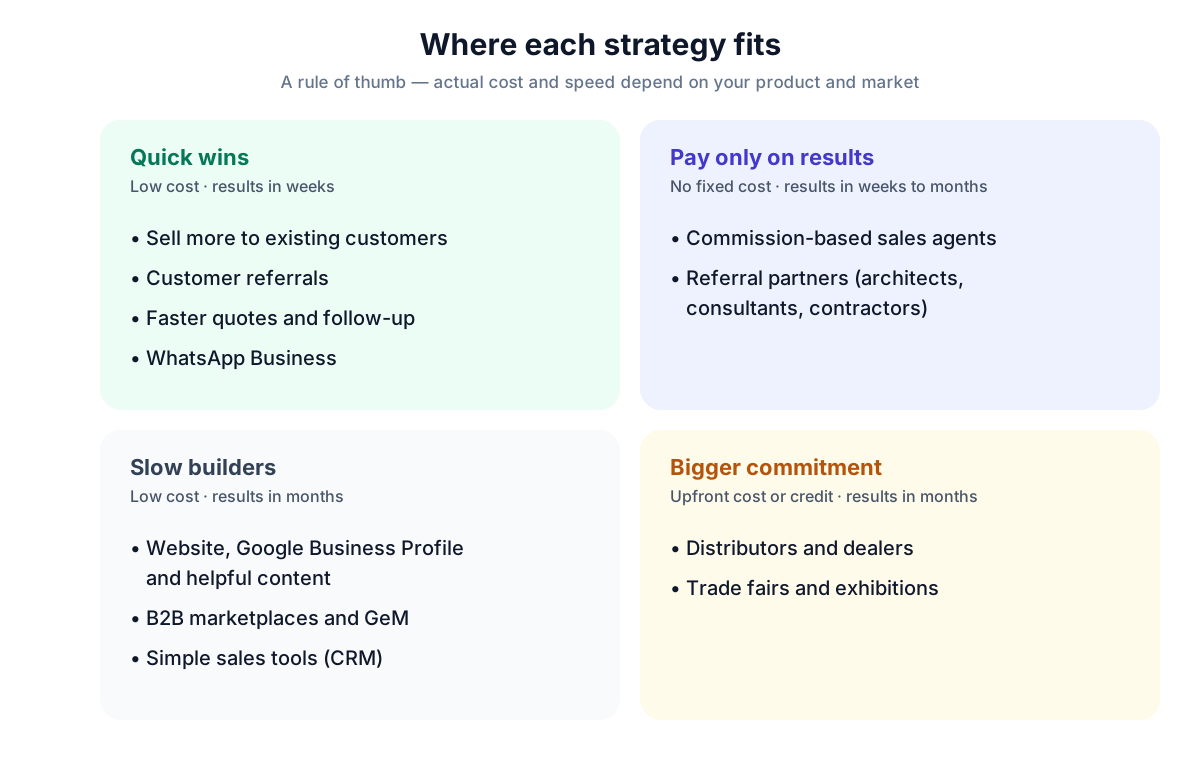
| Strategy | Upfront cost | Time to results | Best for |
|---|---|---|---|
| Existing customers | Very low | Weeks | Every manufacturer |
| Customer referrals | Low | Weeks | Products with happy, connected buyers |
| Commission sales agents | None until a sale | Weeks to months | Reaching new cities and buyer segments |
| Referral partners | None until a sale | Weeks to months | Products specified by professionals |
| Distributors and dealers | Margin and credit | Months | Fast-moving, stocked products |
| Marketplaces and GeM | Low | Weeks to months | Standard products buyers search for |
| WhatsApp Business | Free | Days to weeks | Repeat buyers and quick enquiries |
| Trade fairs | Medium–high | Months | Launching products, finding partners |
| Website and content | Low–medium | Months | Long-term, compounding demand |
| Faster follow-up | Very low | Immediate | Every manufacturer |
Where to start: a 90-day plan
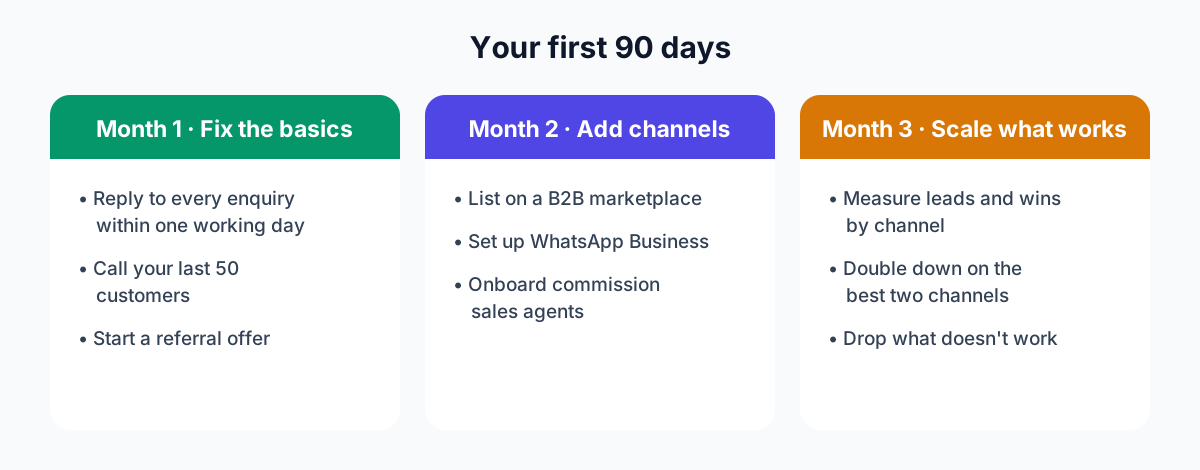
- Month 1 — Fix the basics: reply to every enquiry within a day, call your last 50 customers, and launch a simple referral offer.
- Month 2 — Add channels: complete a B2B marketplace listing, set up WhatsApp Business with a catalogue, and onboard your first commission sales agents.
- Month 3 — Scale what works: count leads and closed deals by channel, put more effort into the best two, and drop the rest.
The point of measuring by channel is simple: it tells you where your next rupee and hour should go. It also tells you, with evidence, when it finally is the right time to hire.
Common mistakes to avoid
- Trying all ten strategies at once and doing none of them well.
- Adding channels while enquiries already go unanswered — fix follow-up first.
- Offering agents or partners a commission too low for the effort involved.
- Keeping commission and referral terms verbal instead of written down.
- Not tracking where each order came from, so you never learn what works.
When hiring does make sense
Hiring becomes the right move when a channel is clearly working and demand is outgrowing your capacity to serve it — for example, when one region consistently produces more qualified leads than your team can follow up. At that point you hire with data, for a proven market, rather than hoping a new person will create demand from scratch. Many manufacturers keep commission agents for new regions even after building an in-house team; compare the options in outsourced sales team options for SMEs.
Frequently asked questions
- How can a manufacturer increase sales without hiring employees?
- Start with existing customers (repeat and larger orders), add a referral offer, and fix follow-up so every enquiry gets a fast reply. Then add channels you pay for on results — commission-based sales agents and referral partners — plus online channels such as B2B marketplaces and WhatsApp Business.
- What is the cheapest way to increase B2B sales?
- Usually your existing customers and your own follow-up. Calling past customers, offering supply contracts and replying faster to enquiries cost very little and often produce results within weeks.
- Are commission-based sales agents a good alternative to hiring?
- For many SMEs, yes — especially for reaching new cities or buyer segments. Agents are paid only when a deal closes, so there is no fixed cost. You still handle pricing, delivery and the customer relationship.
- Should I use distributors or sales agents?
- Distributors suit fast-moving products that need local stock. Sales agents suit products sold order by order, such as machinery, solar systems, furniture projects and packaging. Many manufacturers use both.
- How long does it take to see results?
- Quick wins like follow-up discipline and calling past customers can show results within weeks. Agents, marketplaces and referral partners typically take one or two sales cycles. Website and content build over months.
Add a sales network without adding payroll
List your products on BizSathi, set your commission, and let KYC-verified agents across India bring you buyers. You pay only when a deal closes.